Showing posts with label Ben S.. Show all posts

Tuesday, October 20, 2015

The Democratic Republic of the Congo…

…should be one of the world’s great tourist hotspots.

by Ben S.

Within a compact area in its far east, up against the Rwandan and Ugandan borders, you can observe some of the last remaining mountain gorillas, track chimpanzees through the forest, gaze upon the world’s largest lava lake, jump crevasses on Africa’s only glaciers, and swim in the crocodile and hippo-free waters of Lake Kivu.

Unfortunately, the deadliest conflict since 1945, a refugee crisis, rape epidemic and widespread crime, corruption and disease mean that, while the region is full of foreign visitors, travel companions are far more likely to be UN soldiers, NGO bureaucrats or European war correspondents than fellow tourists.  Things are slowly changing – since rebels were pushed out of Goma and into the forests in 2012, a steady trickle of curious visitors have crossed the border from Rwanda to climb the Nyiragongo volcano and commune with great apes, all under the watchful eye of armed rangers from the Virunga National Park.  

The first few days of my trip this past summer were under the protection of the park authorities.  One night was spent in the understated luxury of a private bungalow at the Mikeno Lodge, watching monkeys from the terrace and guided nature walks in the forest.  Another I sat drinking wine by a campfire with South African financiers and American NGO workers outside $280 per night safari tents, eyes shining and voices trembling as recent memories of encounters with mountain gorillas were recalled.  Another night was passed shivering atop a 3500 metre volcano, awestruck at the sight of the cauldron of lava bubbling below, while porters concocted a delicious dinner in the subzero night air, the armed rangers and friendly, informative park staff a constant, unobtrusive presence.  Magical, unforgettable, cliché-ridden and budget-destroying memories made, in as much security and peace of mind as perhaps is possible in the Congo, thoughts of war and death far away.

At the end of my trip, being deposited in Goma – the chaotic, often-destroyed/occupied/bombed, lava-strewn hub of the region, where the harsh, knife-edge realities of Congolese life play out to the tune of the whirring of UN helicopters and – in bad times – sounds of grenades and gunfire – I waved goodbye to my park ranger escort and realised that I was alone in Congo and under nobody’s protection other than my own.  Well, not quite.  I had found a local’s email address online and asked him if he’d want to be my guide for a few days.  We had agreed to meet for a drink and to discuss plans.  A part of me wasn’t entirely convinced that this was necessarily the safest or most reliable way to travel in Congo, but a $2000 2-day trip with a travel agency wasn’t really an option.  And so it was that I found myself meeting Rene, and agreeing to travel with him to his ancestral homeland of Idjwi island.

 photo map1_zps71z8sjsr.jpg

 photo map2_zpsvjslnr4j.jpg

Idjwi’s claim to fame is being the world’s tenth largest inland island- a source of pride to many a local – but perhaps it should be better known for its appallingly high rate of tropical diseases and 27 year life expectancy.  It was odd to think that, in the week before turning 30, I’d be on borrowed time by island standards.  About the only information you can find in English about Idjwi is a Vice article on the healthcare crisis on the island – incidentally I was to find myself eating pasta in Goma the night before my trip with the British journalist who wrote that article.  Rene had told me we’d need to be up at 5am in order to catch the ferry to the island, and that in order to get to the port, we’d need to hire motorbike taxis.  Having made it to 29 without ever sitting atop a two-wheeled contraption of death, this prospect scared me more than any of the other numerous likely ways to die* in and around Goma, not least because the city roads largely consist of potholes surrounded by lava rocks (a legacy of the 2002 destruction of the city by volcanic eruption).

 photo DRC14_zpsr2oak7m8.jpg
*including, but not limited to, rebel grenade attack, war, volcanic eruption, asphyxiation by sudden release of noxious gases from Lake Kivu, any one of numerous tropical diseases, chimpanzee attack, being run over by NGO landcruiser.


The early start wasn’t really necessary, as one boat was cancelled, the next one broke down (after we had departed; fortunately it managed to eventually limp its way back into the dock), and in the end, after much chaos, shouting and confusion, we managed to get tickets for the 9pm departure.  And so the day was spent hanging out in Goma with Rene’s family, learning key phrases in Swahili and Kihavu, taking more terrifying moto rides (I eventually began to relax my deathgrip on the driver, and even managed to eventually take photos while riding), and discussing plans for my stay on the island while being reassured that, yes, while many boats do sink and many people drown every year, our boat was safe and we’d definitely arrive unscathed.  Eventually we made our way back to the port and made our way onto the boat.
 photo DRC15_zps7o3vvyj6.jpg

 photo DRC11_zpsbm7gzo4o.jpg

And so the adventure really began.  To describe Idjwi as ‘undiscovered’ would be an error.  Hundreds of thousands of conflict-fleeing Congolese have discovered a peaceful, safe haven on the island in the last few years.  For while Idjwi is lacking even by Congolese standards in healthcare and basic development (there are, for example, 10 cars on the island – one per 25,000 people, outnumbering doctors by a considerable margin), it is at peace.  Malnutrition is rife, employment almost non-existent, and the poverty striking, but it’s a world away from the palpable tension of the mainland, with its blue helmets, forbidding compounds and the constant sight of guns.  My time on the island was spent talking with locals, swimming in the lake, eating tiny fried fish and riding on the backs of yet more motorbikes along dusty red tracks, looking out over the hilly, tree-drenched coastline and glassy waters of the expansive lake. 

 photo DRC13_zpsa8niaofh.jpg

 photo DRC3_zpsz9wrek8t.jpg

 photo DRC6_zpsz7i8u1yi.jpg

 photo DRC8_zpspc9bfipk.jpg

 photo DRC2_zpscoc9r338.jpg

Somehow it felt wrong to be so relaxed while aware of the brutal statistics about life and death in this rural idyll, but everyone I spoke to was glad that I had come and wanted me to get the word out to encourage more visitors to their island.  Visiting is neither easy nor comfortable, but as a side-trip to the spectacular but tourist-packaged Virunga Park experience, a few days on Idjwi before catching the morning boat to Goma’s even more frenetic, chaos-ridden Southern counterpart, Bukavu, is something I’d highly recommend to any tourist in Congo.

When I think about my short time in the Congo, it’s not the gorillas, the volcano or my decadent bungalow in the jungle which come straight to mind.  Nor is it war and the news reports of untold human suffering it brings. Rather, it’s jumping off the bow of an overcrowded ferry into a reedbed before dawn and scrambling in the dark up a steep bank of dirt to wait for a lift to the village which may or may not come.  It’s sitting on the elevated terrace of a bar in Bukavu buying beers for a wanted man (he swore he was innocent) while he shows me the ‘WANTED’ poster with his name on it as the military search for him through the streets below.  It’s that first, heart pounding ride on a motorbike through the chaos of Goma, clambering over sacks of vegetables in the coffin-dark hull of a supposedly unsinkable boat, frowns turning to smiles at a Swahili greeting.  Not just the world-class attractions which hopefully, one day, will bring in the tourist hordes, but simply being in Congo and the tiny moments that, together, make for one big, unforgettable adventure.

Saturday, January 5, 2013

Elista: Desolate Disappointment

By Ben S.

Elista, capital of the Republic of Kalmykia, world capital of the noble game of chess and largest Buddhist city in Europe (not that there are that many places vying for that accolade), ranks highly among my list of ‘Biggest Travel Disappointments.’ 

For this, I blame Daniel Kalder and his book ‘Lost Cosmonaut’ (reviewed by DT here). Having read it a few years ago, long before I had ever set foot in the Former Soviet Union, his description of the Kalymk capital conjured up images of an absurd wasteland on the sad periphery of Europe, trembling under the megalomania of a chess-loving, enemy-assassinating dictator while slowly disintegrating into the dust of the endless steppe surrounding it.  I enjoyed the book and its description of Kalymkia, and was intrigued by idea of a Buddhist enclave within Europe which was obsessed with chess and had nothing of any consequence to offer the world.  Although then an armchair desolationist as yet uninitiated to the joys of travel in the fringes of the Soviet empire, the book sparked my imagination and never faded from my memory.

Last spring, I spent a week in Southern Russia visiting a colleague.  I was staying in the small industrial city of Volzhskiy on the outskirts of Volgograd.  It was my first (and so far only) trip to Russia, and a quick glance at the map showed that the city of Elista was only a hop, skip and a jump away across the steppe.   I couldn’t conceive of any circumstance where I would only be 2cm. from Kalymkia again (although 2cm. on a map of Russia transpires to mean a five hour journey each way), and so naturally I decided to go.  On a day trip.

Ten hours of travel to spend two hours at a destination might seem absurd, and that would be because it is.   Fortunately, my friend found some others who were happy to make the trip, and so I caught a lift with them.  The scenery on the journey varied between monotonous green and brown grasslands and the back of my eyelids as I was bored into unconscious inertia.  One highlight was passing through a village populated by emigrants from the Caucasus, where signs advertised delicious Georgian, Chechen and Azeri food.  Unfortunately, I was travelling in a car full of local Russians, who were horrified by the idea of stopping at a place where ‘the people aren’t even from this country.’  This was distressing, as I love khachapuri, and having it surrounding me but being unobtainable was a form of psychological torture. Besides that one village, and a brief stop for a domestic dispute between two of the car’s passengers, there was just more grass of varying shades of brown and green.  I came to the conclusion that steppe is not among my favoured landscapes, and that the best remedy is sleep.  Which is hard to do in a car with dodgy suspension and no air-con in 40 degree heat.

Photobucket

Elista itself wasn’t worth the trip, although that’s not to say that I’m not glad I didn’t go, or that I would discourage anyone else from making the journey if they just so happen to be in the area (the chances of that happening are, I suspect, slim).  It’s quite a pleasant, tidy-looking little Russian city with a couple of (obviously new) pagodas and Buddhist-themed statues/kitsch/crap, a huge (new) Buddhist temple and a few Asiatic-looking people walking around speaking Russian.  If foreign tourists were ever to descend en masse to Kalmykia, they might bemoan the lack of ‘authenticity’ without realising that this is in fact as authentic as it gets.  The Kalmyk are a Buddhist people, but they are also Russian and European.  Expecting a Soviet Shangri-La would be ridiculous.  My Russian car-cohabitants were unimpressed, walking morosely in the wrong direction around the temple to the consternation of the Kalymk praying inside.  

Photobucket

Photobucket

Photobucket

The much-touted ‘Chess City,’ a ridiculous project created by the aforementioned dictator on the outskirts of Elista, was disappointingly low key.  The megalomania I had been promised wasn’t as evident as I had hoped, the place looking to me like a chess-themed industrial estate on the outskirts of any provincial town.   

Photobucket

Photobucket

Photobucket

We didn’t go to the restaurant which purported to serve wolf meat, as our two hours were up and it was time for the long journey back home. 

We had seen all there was to see.

I expected desolation in a savage, absurd wasteland, and instead I found mediocrity with a few bits of Disneyfied ‘Asia’ scattered around.  Perhaps Elista was once as described in the book, but now it feels much closer to the Russian mainstream, with the addition of a Mongolian consulate and giant golden temple.  If one searches for desolation and doesn’t find it, then arguably the purpose of the trip has been accomplished.  I was searching for the Elista that Kalder described – an Elista which, if it ever existed, seems to have now moved on.  I’m glad for the Kalymk people, and I’m happy to have seen the reality for myself.  But I can’t help but think two hours in Elista is an hour too long. 

And that I really, really am not a fan of steppe.

Holiday in Abkhazia

By Ben S

I am disappointed with the name the people have chosen to call their country.  Apsny.  It sounds to me like some kind of gelatinous substance which might be produced by a particularly severe throat infection and then unceremoniously hacked up in a violent coughing fit.  For once, English has the good sense to use a more exciting, exotic-sounding name:  Abkhazia.  For a people blessed with a beautiful language renowned for its onslaught of consonants in unimaginably complex clusters, I can’t help but feel the Abkhaz did not reach their full potential when naming their country. 

Friends of mine have blazed the trail before me Abkhazia, while a recent warzone and an unrecognised state to which the British Foreign Office advises against all travel (under any circumstances), is not virgin territory among my cohort of intrepid friends.   Thousands of Russians and a sprinkling of westerners have preceded us.  We are not explorers, just tourists.  We are on holiday- a chance to kick back, relax, and enjoy the scenery without worrying about work, bills and other mundane matters.  While sitting in the charming Cafe Lika in central Sukhumi, Lika herself brings over the visitor’s book and proudly points at the only English-language entry.  Apparently the previous foreign visitors found Lika’s hospitality and great cooking a relief after having been detained for 18 hours by the Abkhaz police.  We hope we don’t suffer a similar fate in this lawless non-country where we have no diplomatic representation.  After all, we are tourists.  Trouble and excitement are far from our minds.  We just want a relaxing holiday.

My original intention had been a long weekend at a pleasant, rustic hostel in the Tatra Mountains of Slovakia.  A bit of walking in the pine forests, a trip on a cable car, maybe a tour of Krakow.  I ask my friend W if she would like to come along.  She suggests Georgia, trusting me to take us somewhere ‘suitably dangerous, with delicious food.’  So, my relaxing long weekend in Eastern Europe turns into a two week jaunt around the Caucasus.  Not that I’m complaining – like all sensible people, I have wanted to visit Georgia since I first discovered its existence.  And the food is certainly delicious.  It seems rude to visit but not to venture into Abkhazia, former warzone now Russian beach holiday paradise.  Getting in is now just a matter of applying for a visa and paying $20 – easy.  So it is that we emerge from an overheated, urine-scented train at Zugdidi as dawn is breaking, eager to find a taxi driver to take us to ‘the border.’  

Photobucket
Ben Scott at Zugdidi

But of course, it’s not really a ‘border,’ because to call it a ‘border’ would confer legitimacy on the brutal, evil and totally illegal Abkhaz government- really just a bunch of criminals lording it over an integral part of Georgia.  In a hushed and needlessly urgent tone, I ask the taxi driver if he’s willing to take us ‘to the river; to Ingur.’  Nudge, nudge, wink wink.  ‘To the border?’ he asks, motioning for us to get in.

The ‘border’ is closed when we get there, the Georgian police officers sleeping in their hut.  I decide it probably wouldn’t go down to well to wake them up in order to ask permission to leave Georgian-Georgia and cross over the river to the part of their country which is presently and inconveniently occupied by Russian soldiers.  So we sit in the sunshine watching the pigs, and wait.  After a while, there are signs of movement, visits to the privy and shower and then, finally, signs that the working day is to begin.  The Georgian policeman on duty doesn’t look thrilled to see us there, but we are not the first westerners to have passed through, and as Abkhazia is still legally part of Georgia he can’t block our passage.  With an air of resignation, he takes our details and asks where we plan to travel.  An impassioned, frustrated speech about the unfairness of it all – how foreigners such as us can travel freely whereas he is trapped, unable to cross the river to see what lies on the other side.  We sympathise, and offer weak platitudes that maybe better times await in the future.  Then, trying not to skip with joy, we head for the border and the other side.  It begins to drizzle, as we sit in the back of a clapped-out horse-drawn cart, wending our way past puddle-filled potholes and past hunchbacked refugees cloaked in black.  

Photobucket
Crossing the 'border'

Our driver sings a mournful song and salutes the young Georgian soldier guarding the free world against the Russian enemy.  We stop at a gate – Russian soldiers eyeing us on the other side while harassing ethnic Georgian refugees.  It all looks a bit forbidding and ominous.  Not like a holiday place.   Even the uniforms look scary – no smart police-style outfits now, just fatigues and what are, I suspect, Kalashnikovs.   We have crossed the edge of the known world of diplomatic protection and European human rights laws, and have entered a new space.

Our stay in Abkhazia is relatively uneventful.  There are no wars, arrests, or ethnic cleansing.  There are also no non-Russian tourists, and certainly no other Asian faces besides W’s.  The Minister of Foreign Affair’s taxi-driving brother-in-law rips us off and then drives off with our luggage in the back to pick up another fare.   We wonder if we’ll ever see our bags again, but eventually he returns.  We stay at Amra’s dilapidated apartment in the Sukhumi suburbs.  She is nice enough, but desperate to sell me a pair of fake Levis and a huge jar of honey.   Unfortunately, space is at a premium in my bags, so I decline the offer.  We only hear gunshots outside her apartment once, but she warns me that Sukhumi nights bring dangers for people like us, and insists we are home before dark.  We meet the Minister of Foreign Affair’s mother on a bus to Gagra.  She stares at W for a long time, before enquiring politely where we are from.  A man in Sukhumi approaches W while brandishing some Uzbek money, asking her to ascertain the value of ‘her people’s money’ in Roubles.   A member of the militsia stares at us and then descends into a deep bow.  ‘Welcome,’ he says.  One man speeds past us as we approach a zebra crossing, gawping out the window as he passes.  The next we hear is the slamming of the brakes and him screeching up the road in reverse.  He reverses past us and then lowers the window, graciously beckoning for us to cross the road.   We suspect that the sight of British and Malaysian tourists lugging backpacks around Sukhumi is not one he often sees.   We meet a few nice people and many nice cats. We visit the Research Centre where monkeys are kept in pitiful conditions, and buy fruit to thrust into their sad, begging hands.  
Photobucket

Photobucket

This is a scientific institute where, during better times, monkeys were trained to be Cosmonauts of the Soviet Union.  I do not suspect that Abkhazia has any plan for simian space travel soon, given the dilapidated ruins which scatter the institute and the sorry state of their inhabitants.  

We sunbathe on the stones at Gagra beach, and I brave a swim in the surprisingly warm November sea.  A gelatinous substance coats my foot and I decide to leave the water.  

Photobucket

Photobucket
Photobucket
Photobucket
We visit the monastery and waterfall at Novy Afon, look admiringly at the towering mountains, deep blue sea and palm trees, and feed bread to adorable kittens while ignoring the swans which glide across the impossibly scenic lake. 

Photobucket
Novy Afon Monastery

Photobucket

Photobucket

Photobucket

Photobucket

Photobucket

Bombed-out buildings are impressively juxtaposed against idyllic park and mountain backdrops.  For the tourist seeking new holiday horizons, all seems perfect.

Photobucket

Photobucket

Photobucket

But something just doesn’t feel right about Abkhazia.  It’s not just the knowledge of what happened here, the horrific ethnic cleansing of Georgians and the atrocities committed during the war.  It’s not even the inconvenience of being unable to withdraw cash, or the inflated prices and inferior food.  The sun beats down strongly even in late Autumn, but there is little of the warmth of Georgia here.  People have been nice, and on a few memorable occasions even friendly, but there is none of the vitality and joy of the other side of the river.  There is tension and people keep their distance.  Post-Soviet service standards seem to be the norm.  No more free wine and smiles.  No more ‘where are you from and do you like my country?’  Taxi drivers quote absurd prices with a predatory gleam in their eyes.  There is sometimes laughter at my attempts at speaking Russian – and not kindly jest.  A man kicks a cat and people tease the monkeys.  Neither W nor I can shake the feeling that there is something bad in the air here.  Yes, the palm trees are beautiful, the snow-capped mountains towering, the beaches nice to look at, and the vegetation luxuriant.   And yes, we have had the pleasure of meeting some charming, friendly people like the wonderful Lika.  But, however much it markets itself as such, something tells me that Abkhazia needs to do more to make itself the holiday paradise it aspires to be.  


Photobucket


The taxi driver who meets us at the Georgian side of the river-which-may-or-may-not-be-a-border gives us a fair price, and we chat in broken Russian.  As we talk property prices, work and food on the short drive to Zugdidi, I begin to relax for the first time in days.  We are back in Georgia.  Back on holiday.

Saturday, March 26, 2011

desoLINKS

I know that we haven't posted anything in rather a while... unfortunately we haven't yet figured out how to make a living off of full time Desolation Travelling, so we all have jobs that keep us boringly occupied doing hundrum and non-desolate things.

Well, except for Joe who is about to get evacuated from Yemen and, as such, is hardly occupied with the humdrum! In fact, prior to the eruption of all the recent violence in Yemen, he did a good bit of travelling (desolate and otherwise) about that country. Here are some links from his pre-evac travels:


Moving on... we've got some pictures from Kyrgyzstan posted on our website, taken by me (Jane) and by Ben S. They can be seen at the following links:

And lastly... this coming August, the Desolation Travel team is going to Chernobyl! In honor of this fabulous upcoming event, here are some articles on Chernobyl which have recently found their way into the news:


Monday, January 31, 2011

Travels Along Tajikistan's Unrefurbished Highway of Death

by Ben S.
To see the complete set of photographs from Ben's trip to Tajikistan,
please
CLICK HERE.

The first thing about Tajikistan is the soup our driver buys us. It is pungent and herby and full of flavour and noticeably lacking in mutton fat, congealed or otherwise. Its scent is as full of the promise of a new land as the brightly coloured shawls of the female customers at the small cafe and the undulating tones and strange syllables of the language they speak. Afghanistan and Iran seem just a breath away, Russia and Turkey’s influence left far behind to the north. This Central Asia, it is altogether new and exciting and different. It is not my Central Asia. I have three days.

“Three days? ! That’s not enough time to see our country!”

At the insistence of the consul, I have dutifully sat at a table in the corner of the Tajik embassy in Bishkek, and in my neatest handwriting composed what I hope is an acceptable self-written letter of invitation to get me my Tajik visa. The walls of the embassy are full of photos promising what beautiful wonders await the visitor to her country. Most of them were taken in Uzbekistan, showing Samarkand and Bukhara, fabled cities of beauty lost to hastily drawn lines on Stalin’s map. Few seem to show anything of the country itself. The photos hark back to the glories of a lost past rather than to the realities of the present. I make my best apologetic pained expression and explain that I only have a week of vacation, and a flight to catch out of Dushanbe at the end of that week. I hope to return to this beautiful country sometime in the future so I can truly appreciate its famous beauty. There is no problem, a visa is granted, the consul just wishes I could have more time to fully enjoy her country. I am going.

The Uzbek-Tajik border is slow and hot and laborious and full of paperwork. Three of us cross one way, two cross back the other. The border is closed for lunch but I am fortunate enough to meet Tanja and Jochem on the Uzbek side. Tanja charms the gun-toting guards and they let us through. We are ushered from gunman to gunman and each time escape without paying a single Somani. Tanja and Jochem know all about me and my life because they have overheard me talking with a curious Uzbek woman the night before in Samarkand. They are nice people and we decide to share a taxi together to Penjikent town. Our taxi driver buys us soup and takes us on a tour of the ruined city. All is dust and barren mud, the ruins of an ancient Sogdian civilisation crumbled into holes in the ground and remnants of what may have been walls. Penjikent fries in the harsh sun hundreds of metres below.
Photobucket

We negotiate for transport to Dushanbe for an hour before agreeing to pay $100 for a car to take us over the mountains to the city. I stand around chatting to the town’s English teacher. He can’t speak much English but is happy to have the chance to practice with a native speaker. There is but one in the town.

“Don’t take the road from Penjikent to Dushanbe. It’s too dangerous!”

An email from the town’s English speaker tells me that the road is closed all day for rebuilding by Chinese crews and that traffic can only make the drive from 6pm, in the dark, on an unbuilt, rocky, hole-strewn road winding through the high mountains above gaping chasms with no safety barriers. People regularly die on this road in the darkness, as drivers are often drunk, drive too fast and with no care for safety. I am strongly advised to enter Tajikistan further south and take the direct route to Dushanbe. Do NOT take the road from Penjikent to Dushanbe!

On the road from Penjikent to Dushanbe, we leave town under the watchful eye of a poster of the dear president (who is surrounded by a bevy of admiring prepubescent schoolgirls) and it begins to rain. The road disappears and becomes a river of mud sliding over the edge of a cliff. I take pictures and wonder if I should have heeded the advice not to take this road. All is nothingness, just bare earth, towers of rock and the omnipresent chasm waiting to devour us. I feel like a hobbit entering Mordor.
Photobucket


Photobucket

At Ayni we are stopped and our passports examined. We join a convoy of traffic idling, waiting for the gate to open so we can proceed to drive into the high mountains to the capital. Three teenagers come and chat to us in English. They like living in Ayni but want to move one day to the big city. They speak better than the English teacher in Penjikent. One day they want to go to America.

The gate opens as dusk falls, and we roar off in dust and a hail of small stones. Nothing can be seen through the windscreen and I wonder how our driver knows where the road ends and begins. Maybe he doesn’t. We rest at a small tea shop perched above another chasm, and eat delicious meat and drink tea from dainty cups. Night falls and it turns cold. I walk away from the cafe and there is nothing but silence, blackness and a million stars spangled across the sky. I feel very far away from home. My friends in Kyrgyzstan were worried about me making this trip, speculating over whether or not I would come home dead. I feel very much alive, and young, and free, and adventurous. I am on the road from Penjikent to Dushanbe and the world is at my feet.

Back in the car and we are driving again, alone this time as the convoy has long gone ahead of us. In the blackness we can only imagine the outlines of the mountainous walls of rock looming above us. The chasms are still visible, their blackness being even darker than that of the sky. We approach the edge often to drive around gaping holes in the road and to pass the abandoned machinery of the road-builders, but the tyres stay on course. Eventually we enter the Varzob tunnel, where dull strip lighting shows us that the water is tyre-deep, and we see the wires hanging from the ceiling and industrial detritus scattered around like post apocalyptic confetti. We are swallowed by the earth into its eerie dankness before finally being disgorged into yet more darkness on the other side. The stars reappear and light our way to Dushanbe.

The president’s house on the edge of town is bigger and more brightly lit than those of the surrounding heroin barons. Gaudily festooned with fairy lights for a dinner of the heads of states of the Shanghai conference, who will be arriving in town tomorrow, it is reminiscent of a doll's house on crack. It is thoroughly absurd after the shacks of the Tajik mountain villagers and given the electricity crisis that has plagued the region. For the convenience of the esteemed guests, the road will shortly be closing, so our driver puts his foot down so we can make it into Dushanbe.

It is midnight and we arrive in Dushanbe hours ahead of schedule, with nowhere to stay. Our driver would put us up at his house, but it is a little cramped as he has many children. He takes us to the taxi driver’s hostel, a house squatting under the belching stack of the city’s cement factory. For 3 Somani we have some blankets on the floor and a teapot. A gruff Tajik man brings us tea. I am the first Englishman he has seen, and he proclaims that he will judge all of my kind based on his encounter with me. I am not sure if this is a good thing or not. At least, like Belarusian Tanja, I am not known for my lack of generosity and failure to bring flowers when visiting a house. All Belarusians are like this. There is no room for individuality; the constraints of nationality define us as human beings.

Photobucket

The next day we wander into the city. The streets are litter-free and suspiciously clean. Men in suits and sunglasses stand on every street corner, watching passersby and talking into their radio headsets. Propaganda proclaims the marvelousness of the Shanghai Conference, the greatness of the president, the unending ties between Tajikistan and the People’s Republic of China. The buildings are built in endearing shades of pastel and the avenues lined with trees. It is a pretty place, with fountains and photogenic architecture. It seems much smaller, calmer and more genteel than other Central Asian cities, and we encounter no hassle from the police anywhere. We make the mistake of deviating from the established route in the National Museum and are sternly rebuked for doing so. I see a giant reclining Buddha, and search for postcards. My favourite postcard shows the headquarters of the National Bank. Why would anyone come to Tajikistan for pointless road trips amid the high mountain beauty of the Pamirs when they could spend time admiring the National Bank instead? Crazy foreigners.

My hotel for the night is the Vakhsh, a pretty pastel building hiding a damp threadbare exterior. I am not allowed to check in, as I am foreign and strange. Tanja returns to help me purchase a room for the evening. Soviet solidarity eventually pays off and I am in. $30 buys me a sagging bed and bathroom with noisome and recalcitrant plumbing. Scowls from the receptionist are free of charge. I meet Tanja and Jochem for Ecuadorian food in the north of the city. Salsa is undoubtedly the best Ecuadorian restaurant in Central Asia. I walk back alone through the city. There is nobody on the street besides a horde of militisya. Not one troubles me for some Dollars or even Somani. I wonder if I am still in Central Asia, or possibly hallucinating.

“The flight has already gone!”

The next morning there is trouble at the airport. A baying horde are wailing at the entrance, demanding to be allowed to go to Moscow. I ask the man in uniform when I can check in for my flight to Bishkek. I am told that the flight has already left, even though it is not due for another four hours. Customs officers carry melons and leave them in a side office. The bringers of melons are allowed through to the coveted check-in area. I wonder where I can buy some melons to give as my own bribe. I ask at the information desk about the flight to Bishkek and am told no. I’m not sure what ‘no’ means, but I don’t think it’s good. A pretty young Tajik woman standing next to a fat sweating white man tells me to wait with them, as the fat man is also headed for Bishkek. He is from Arkansas and is in town to close down a company. He seems pleased by this. He doesn’t speak Russian and doesn’t like it here. The Tajik woman, who is charming and enthusiastic, is his fixer. Another Tajik joins us. She speaks excellent English and works for Help the Aged. She is off to Bishkek for work, and will soon be going to Brighton for a conference. I am asked what Brighton is like. I describe this cosmopolitan, bohemian seaside city but leave out the part about its thriving gay life. I’m not sure if it will go down well. She is only the second Central Asian I’ve met who has either been, or is going to, my country. The other one also worked for an NGO.

“But my secretary organises things like that for me!”

Eventually our flight is called (Ben 1, man in uniform 0) and we proceed to check-in. At immigration, it turns out that Arkansas dude hasn’t got a Kyrgyz visa and won’t be allowed to proceed through customs. NGO lady thinks he is stupid, and from her smile I can tell that fixer lady agrees. Fixer lady passes me into the care of NGO lady, and I whisk through customs without needing to open my wallet. An immigration guy with an eye for opportunity sighs as he looks at my passport and asks where my migration pass is. NGO lady scolds him and tells him to cut out his nonsense, and he withers under her gaze. I am through, and continue telling her about Brighton.
Photobucket

The flight back is on Kyrgyzstan Airlines, who are barred from entering EU airspace. I am served a nice in-flight meal and, while the seats do rattle and it is too noisy to speak, the flight is not unpleasant. We land back at Bishkek and I am besieged by taxi touts quoting me absurd prices to get to Bishkek. I am home. At my school compound, I am greeted by the director who cheerfully announces that she is surprised I made it back, and that many of the staff thought I wouldn’t make it. I bring giardia back with me and am sick for days. I lose so much weight I need a new hole stamped into my belt to hold my trousers up.

I meet Tanja again some months later on a cold day in England. She is in the country for a conference and we decide to meet up at an Iranian restaurant in the inner suburbs of London. It is nice to see her again and we reminisce about journeys taken and talk about journeys yet to come. The stew arrives, herby and pungent and full of promising aromas.

The Tajik consul in Bishkek, I think she may have been right.

Wednesday, December 29, 2010

Desolation... Madagascar?

by Ben S.
[The complete set of photographs from Ben's trip to Madagascar can be seen by
CLICKING HERE.]

Trying to work the desolation angle into an article about Madagascar was never going to be easy. The ‘D word’ is the last thing you’d usually think of when pondering this vast lemur and vanilla-pod filled, rum-soaked island fringed by swaying palms and white sand beaches. And, despite being a relatively devoted desolationist, I did not actively seek desolation in Madagascar. Truth be told, I wanted to kick back for a few days and relax in a sunny tropical paradise. In short, I wanted a vacation. It could be said that I went due to desolation rather than in search of more.

Somehow, my plan to spend a cheap week relaxing on the beach in the Spanish Canary Islands crumbled into dust when I saw that Kenya Airways were having a promotion for under 26s only. Being 25 is a privilege that does not last a lifetime, and I decided to capitalise on it while I still could. And, being a sucker for a silly name, when I saw that Antananarivo was on the list of discounted destinations there was really no other choice – a reservation was made for a flight leaving in one month’s time to be kept on hold for 24 hours pending payment (although I actually held out for an impressive 5 days before eventually succumbing and passing on my credit card details...and this after plenty of pestering from my increasingly more desperate travel agent). Undoubtedly the most expensive thing I’ve ever purchased on a whim.

Madagascar is not a place that people usually visit without months of pre-planning and then for a mere 10 days. The expense of flights, lack of reliable public transport and shocking state of many of the roads means that this is very much a destination for those with time on their hands (and more often than not, a private car and driver). Travelling for 10 days on a medium budget is far from the tourism norm there; Madagascar is an ideal destination for penny-pinching backpackers and for high-rolling dedicated ornithologists and herpetologists with their impressive zoom lenses and associated length-based envy and competitiveness. Deciding on an itinerary can be heartbreaking when you have so little time and so many things to see, so expectations have to be lowered. I quickly determined that my trip would be worthwhile provided I could see at least one rice paddy, one lemur, and one beach.
Photobucket


Photobucket


Photobucket

All of this was thrown into disarray a mere week before departure when, on election day, a group of disaffected military officers decided to stage a coup. News of this development was initially warmly received, but worry ensued once it became clear that the first stated aim of the junta was to close the airport. A few anxious days later and it turned out that the coup leaders didn’t really have much drive or ambition and the whole sorry affair fizzled out...which while disappointing, also meant that at least my holiday plans weren’t ruined.

So, in any case, I came, saw and came back relatively unscathed. In brief, Madagascar proved itself to be a safe, welcoming destination full of friendly, hospitable and endearing people, filled with one-of-a-kind wildlife, with an ample supply of rice paddies and beautiful white sand beaches (and yes, scores of gambolling lemurs of all shapes and sizes). The relentless multicoloured tropicality of the place hardly lends itself to thoughts of the gloomy grey desolation that often springs to mind (in a nice way) when thoughts turn (as they inevitably do) to the Former Soviet Union, but that is not to say that none can be found.
Photobucket

I expected to encounter hideous, shocking poverty at every turn in this, one of Africa’s poorest nations; however, while undeniably poor, with the exception of a few emaciated urban child beggars, most of the poverty is of that charmingly photogenic type that attracts the camera lens without tugging at the heartstrings. The decaying remnants of French colonial infrastructure stand as a beautiful testament to history rather than a representation of economic stagnation. The relative lack of tourists is a bonus rather than a sad reflection of political scaremongering by unfriendly governments needlessly putting people off visiting this safe and friendly nation; its bounty of completely unique attractions that deserve to be visited by camera-toting hordes rather than a few die-hards and wildlife fanatics. I even wandered around the mean streets of Antananarivo under cover of darkness despite the stern warnings of my government not to do so, but all my encounters with Malagasy (and foreigners as well) were notable for the warmth and kindness encountered. While undoubtedly a destination for the more adventurous traveller (due to the terrible local transport and road conditions rather than any great discomfort), this is one of the most hassle-free places imaginable. Corruption and personal safety issues barely register on the consciousness, and stern travel warnings issued by faraway governments fade into a murmur.
Photobucket

And yet, despite all that has been mentioned above, I couldn’t help but think of Kyrgyzstan while in Madagascar. On paper, the two countries are worlds apart but the similarities are there nonetheless. Both have a great deal to offer the traveller who wants an ‘authentic’ experience in a spectacular natural environment and to get up close and personal with local cultures. Both were plundered by a larger colonial power and have been left to stagnate ever since. Both are difficult to travel in unless you are willing to put up with a great deal of discomfort or to shell out for private transport (this being much more the case on the Red Island than in Central Asia). But above all, when leaving, one is left with the feeling that the current downturn in tourists due to the combination of political crisis and unreasonably high airfares is absolutely criminal for countries which have so much to offer and for whose citizens deserve to reap the benefits of a bit of extra hard currency. I can’t say that I’d recommend Madagascar for everyone – you do need at least some interest in the highly-specialised local wildlife and culture in order to truly appreciate the place – but nonetheless I for one would feel happy if the tourist industry picked up and a few more planeloads of tourists arrived each week.
Photobucket

So, while I have undoubtedly failed to introduce a desolation angle here despite shameless and misguidedly obvious attempts to do so, if nothing else I hope that the message comes across loud and clear: GO!

To see the complete set of photos from Ben's trip, CLICK HERE.

Tuesday, October 19, 2010

Festive fun and frolics

A Christmas Day journey to Aralsk, Kazakhstan by Ben S.
CLICK HERE to see the complete set of photos accompanying this post

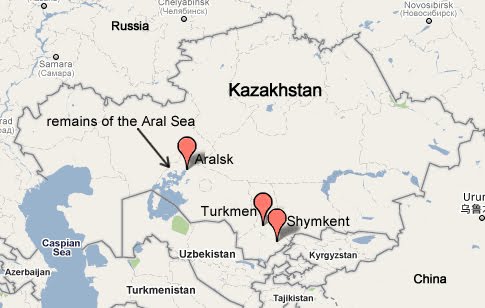
Much like prison, it is easier to arrive in Aralsk than to leave. This fact was starkly brought home to me while standing in line for three hours at the ticket counter inside the rail station, trying to get the ticket seller’s attention while veterans of the Great Patriotic War, Kazakh nationals, passengers’ relatives, other ex-Soviet citizens and indeed anyone who wasn’t a western tourist was waved to the front of the line. The only other western tourist in Aralsk at that time was my friend and travelling companion, unfortunately unable to join my vigil at the ‘kassa’ due to having to run off at intermittent periods to vomit in one of the station’s somewhat less-than-hygienic toilets. So at least she didn’t cut in front of me. Eventually, once the ticket seller had made certain that nobody else more worthy of a ticket was waiting in line, she deemed it safe to serve the foreigner and I managed to acquire the last two kupe tickets out of town and back to Shymkent. It was Christmas Day and the best present imaginable.

We had arrived in Aralsk earlier that morning following an all-night train journey from Turkestan as part of a rushed trip through Kazakhstan. Aralsk was once Kazakhstan’s main (only?) port on the shores of the fish-filled Aral Sea, and now it is the country’s main (only?) ex-port on the ex-shores of the ex-sea. Fans of desolation travel flock here to gaze in wonder at rusting memorabilia of the past. Hulking industrial detritus and eerie corpses of ships lying on the ex-seabed make great photos for those who love the decayed and dishevelled. A mural on the wall of the chilly station waiting room commemorates how the loyal Soviet citizens of Aralsk saved the Soviet Union by providing fish to feed the masses during the Great Patriotic War but now stands as testament to the stupidity and short-sightedness of agricultural experts and planners from that era. The poignancy of the situation is increased by the fact that, while you may ask for a ticket to (or if you’re lucky, from) Aralsk, the ticket will show that you are in fact travelling to ‘Aralskoe More’ (Aral Sea).

Workers of Lenin harvesting wagons of fish...

Do not expect a sea view from the rooms of the town’s only (and overpriced) hotel. In fact, don’t expect much apart from a lack of heating and possible pneumonia. It is however conveniently placed for the ship graveyard and so we dutifully tramped out to the former seabed in the snow, braving the bitter winds and -30 temperatures to get some obligatory photos, before returning to the hotel and desperately trying to keep warm. We also took time to admire the igloo-shaped swimming pool being built on the seabed for the benefit of the town’s population who are now dying due to the various ailments caused by the disappearance of the sea.


After a meal of manty at one of the town's two cafes, we returned to the station to begin the battle to purchase tickets out of town, having resolved to cut our visit short to avoid freezing to death in the unheated hotel. Lovers of old maps might be interested in seeing the huge wall-mounted one at the station showing every single railway station of the former Soviet Union. To see this however, you’ll need to attract the attention of the octogenarian station master. This can be accomplished by being foreign and being in Aralsk station at night. After being barked at and marched to his office, and once it has been ascertained that you are a foreigner, are travelling in Kazakhstan, have a passport and visa, you can try your luck by asking for permission to inspect the map more closely (although this will mark you out as a rather suspicious individual). Alternatively, non-trouble makers can spend their time relaxing at the station’s 24-hour snack bar (something, incidentally, that doesn’t exist at any public transport facility in nearby Kyrgyzstan).


Being ‘stuck’ in Aralsk on Christmas Day is not the most traditionally ‘festive’ experience imaginable. The town is desolate, bitterly cold and lacking in conventional tourist attractions. As often occurs in Kazakhstan, exchanges with officialdom may be less than cosy. But even here, in this forlorn outpost of the Soviet Union overlooked by the oil-fuelled boom of ‘new’ Kazakhstan, there is still a warm glow of festive goodwill to be gained from encounters with residents. Like the pharmacy owner who saw that my companion will ill and opened up specially so that she could buy painkillers. Or, for that matter, the same gruff and suspicious station commander who joined us in the freezing midnight air on the platform as our train pulled in to sweep us back to civilisation. Despite our fears of further interrogation, it transpired he wanted to tell us exactly where to stand on the platform so we could be next to the train doors when they opened.

Aralsk is not Kazakhstan, but it is somewhere to be seen and experienced while travelling through that vast country. I can’t honestly say that I would recommend anyone travel a total of 28 hours just to spend a day in the town, and there are certainly more jolly (and warmer) places to spend the festive season, even in Central Asia. But, with a return ticket in hand, nobody could ever feel imprisoned under what must be one of the biggest, blackest and most star-spangled night skies you’ll ever be likely to see.

Just be sure to buy that return ticket before your departure!

CLICK HERE to see the complete set of photos accompanying this post.