Showing posts with label Russia. Show all posts

Saturday, January 5, 2013

Elista: Desolate Disappointment

By Ben S.

Elista, capital of the Republic of Kalmykia, world capital of the noble game of chess and largest Buddhist city in Europe (not that there are that many places vying for that accolade), ranks highly among my list of ‘Biggest Travel Disappointments.’ 

For this, I blame Daniel Kalder and his book ‘Lost Cosmonaut’ (reviewed by DT here). Having read it a few years ago, long before I had ever set foot in the Former Soviet Union, his description of the Kalymk capital conjured up images of an absurd wasteland on the sad periphery of Europe, trembling under the megalomania of a chess-loving, enemy-assassinating dictator while slowly disintegrating into the dust of the endless steppe surrounding it.  I enjoyed the book and its description of Kalymkia, and was intrigued by idea of a Buddhist enclave within Europe which was obsessed with chess and had nothing of any consequence to offer the world.  Although then an armchair desolationist as yet uninitiated to the joys of travel in the fringes of the Soviet empire, the book sparked my imagination and never faded from my memory.

Last spring, I spent a week in Southern Russia visiting a colleague.  I was staying in the small industrial city of Volzhskiy on the outskirts of Volgograd.  It was my first (and so far only) trip to Russia, and a quick glance at the map showed that the city of Elista was only a hop, skip and a jump away across the steppe.   I couldn’t conceive of any circumstance where I would only be 2cm. from Kalymkia again (although 2cm. on a map of Russia transpires to mean a five hour journey each way), and so naturally I decided to go.  On a day trip.

Ten hours of travel to spend two hours at a destination might seem absurd, and that would be because it is.   Fortunately, my friend found some others who were happy to make the trip, and so I caught a lift with them.  The scenery on the journey varied between monotonous green and brown grasslands and the back of my eyelids as I was bored into unconscious inertia.  One highlight was passing through a village populated by emigrants from the Caucasus, where signs advertised delicious Georgian, Chechen and Azeri food.  Unfortunately, I was travelling in a car full of local Russians, who were horrified by the idea of stopping at a place where ‘the people aren’t even from this country.’  This was distressing, as I love khachapuri, and having it surrounding me but being unobtainable was a form of psychological torture. Besides that one village, and a brief stop for a domestic dispute between two of the car’s passengers, there was just more grass of varying shades of brown and green.  I came to the conclusion that steppe is not among my favoured landscapes, and that the best remedy is sleep.  Which is hard to do in a car with dodgy suspension and no air-con in 40 degree heat.

Photobucket

Elista itself wasn’t worth the trip, although that’s not to say that I’m not glad I didn’t go, or that I would discourage anyone else from making the journey if they just so happen to be in the area (the chances of that happening are, I suspect, slim).  It’s quite a pleasant, tidy-looking little Russian city with a couple of (obviously new) pagodas and Buddhist-themed statues/kitsch/crap, a huge (new) Buddhist temple and a few Asiatic-looking people walking around speaking Russian.  If foreign tourists were ever to descend en masse to Kalmykia, they might bemoan the lack of ‘authenticity’ without realising that this is in fact as authentic as it gets.  The Kalmyk are a Buddhist people, but they are also Russian and European.  Expecting a Soviet Shangri-La would be ridiculous.  My Russian car-cohabitants were unimpressed, walking morosely in the wrong direction around the temple to the consternation of the Kalymk praying inside.  

Photobucket

Photobucket

Photobucket

The much-touted ‘Chess City,’ a ridiculous project created by the aforementioned dictator on the outskirts of Elista, was disappointingly low key.  The megalomania I had been promised wasn’t as evident as I had hoped, the place looking to me like a chess-themed industrial estate on the outskirts of any provincial town.   

Photobucket

Photobucket

Photobucket

We didn’t go to the restaurant which purported to serve wolf meat, as our two hours were up and it was time for the long journey back home. 

We had seen all there was to see.

I expected desolation in a savage, absurd wasteland, and instead I found mediocrity with a few bits of Disneyfied ‘Asia’ scattered around.  Perhaps Elista was once as described in the book, but now it feels much closer to the Russian mainstream, with the addition of a Mongolian consulate and giant golden temple.  If one searches for desolation and doesn’t find it, then arguably the purpose of the trip has been accomplished.  I was searching for the Elista that Kalder described – an Elista which, if it ever existed, seems to have now moved on.  I’m glad for the Kalymk people, and I’m happy to have seen the reality for myself.  But I can’t help but think two hours in Elista is an hour too long. 

And that I really, really am not a fan of steppe.

Sunday, February 6, 2011

DesoLIT: The writings of Daniel Kalder

Reviewed by Jane

Part One: Lost Cosmonaut
Photobucket

I really wanted to love this book. I wanted to be inspired. I wanted to fall so totally in love with Daniel Kalder that I would beg him to please, please, please join the DT team and become our living god. Why was I initially so infatuated? Just check out the back-cover blurb:
Daniel Kalder belongs to a unique group: the anti-tourists. Sworn to uphold the mysterious tenets of The Shymkent Declarations, the anti-tourist seeks out the dark, lost zones of our planet, eschewing comfort, embracing hunger and hallucinations, and always traveling at the wrong time of year. In Lost Cosmonaut, Kalder visits locations that most of us don’t even know exist – Tatarstan, Kalmykia, Mari El, and Udmurtia. He loves these places because no one else does, because everyone else passes them by.
Obviously I couldn’t resist. How could I? Unfortunately, I found the book incredibly annoying. Had it not been about a topic which I love, I probably would've thrown it across the room and left it there. It seemed very much like Kalder was, in fact, a 13 year old boy who had just hit puberty: he mentions cocks and blowjobs way too often, and seemingly for no reason other than to be able to say cock and/or blowjob. He mentions men's genitalia almost as much as
Saffia Farr mentioned her boobs and with even less point. It just seemed incredibly crass. I'm not prudish, but I much prefer something witty (such as when the stuttering Felix Steadiman in Rates of Exchange accidentally offers someone "a nice cock" because his stutter prevents him from uttering "cocktail") to Kalder's frequent and trashy references.

Lost Cosmonaut is… okay. If you get past the crass, juvenile nonsense, he does go to some interesting places of the sort that DT would travel to in a heartbeat; still, it was far from what I’d hoped for. When DT visits Tatarstan, Kalmykia, Mari El, and Udmurtia, we will totally do it better.

Part Two: Strange Telescopes
Photobucket

I almost didn’t read Strange Telescopes. I’d ordered Lost Cosmonaut and Strange Telescopes together, but after reading Lost Cosmonaut I had no desire whatsoever to so much as touch Strange Telescopes. But, as I’m currently living in a country where English language books (outside of ESL textbooks) aren’t exactly easy to come by, I eventually gave in – not so much ‘to temptation’ as ‘out of boredom.’

It was as if Strange Telescopes has been written by someone completely different – or perhaps the puerile author of Lost Cosmonaut simply grew up. I absolutely loved Strange Telescopes.

Unlike Lost Cosmonaut, where Kalder goes in search of desolation itself, in Strange Telescopes, he goes in search of brilliant-but-crazy folks who happen to inhabit bizarre and desolate places. His first subject is Vadim Mikhailov, a man of dubious sanity, whose life is dedicated to the bizarre world located beneath Moscow. Mostly this consists of sewers, although rumors abound of underground chambers, secret metros, and more.
I have rather an obsession with the undersides of cities myself, and I inhaled every bit of this tale with glee. I laughed a lot. And not only did I love Kalder's first tale, but I thoroughly enjoyed the entire book (Kalder’s other insane geniuses included a Russian fellow obsessed with tracking down Orthodox exorcisms in Ukraine, a self-proclaimed Messiah gathering followers in Siberia, and a former 90s-era New Russian who built a ramshackle wooden skyscraper near the Arctic Circle and imprisoned one of his enemies in its basement.) You should read it. Now.

Wednesday, December 8, 2010

Desolation Lost? The Khrapovitsky Estate

A visit to the Khrapovitsky Estate, Muromtsevo, Russia in 2006 by Jane
To see the complete set of photographs accompanying this post, please
CLICK HERE.

(During the 2005-2006 school year, I taught at the
American Home in Vladimir, Russia, which was the starting point for this adventure.)

“Do you want to shoot castle?”
Working overseas often leads to sentences like this, which make little sense at first, and I stared at my student in confusion.
“Maxim and I want to take you to shoot castle. With your camera.”
Ahh. That kind of shooting. In Russia one never knows. I knew nothing about this alleged castle, but I readily accepted.

Soon I was in a car with my two students - both named Maxim - and our adventure began. We drove about an hour outside of Vladimir to the small village of Muromtsevo, in order to explore the abandoned estate of Count Khrapovitsky. Khrapovitsky was of the Russian nobility, and he in the 1880s he built a gargantuan mansion in the Russian countryside, as Russian nobility tended to do… However, he based his architectural designs on medieval German castles, making this estate quite an oddity in Russia. Local legend has it that he was inspired by the castle of a friend in Germany… except that he based his stable on his friend’s castle and modeled his home after something much more grand.

After the Soviet revolution, the Khrapovitsky family fled to France, and the estate was turned into a forestry college. During WWII it served as a hospital. After the war, it was ravaged by fire, and left to disintegrate.

The Maxims and I arrived and found the door barred shut… but that didn't stop them from, shall we say, un-barring the door. We explored several floors, climbing the remains of rickety stair-cases and clambering around on broken rafters and boards placed over gaping holes in the floor, or even in place of where the upper level floors used to be.
The older wing of the Khrapovitsky residence

The Maxims working on entering...


The newer wing of the Khrapovitsky residence


The interior of the newer wing
After we thoroughly explored the castle (and, in the grandest of Russian traditions, consumed a copious amount of wine), we set off to explore the rest of the estate, including the Church of the Holy Martyr Tsarina Alexandra which was commissioned by Khrapovitsky, as well as the remains of his ridiculously ornate stable.

Church of the Holy Martyr Tsarina Alexandra


The stables. Yeah.


The grounds of the estate were once intricately landscaped, although now they are completely overgrown. In front of the castle, there used to be two artificial pools, connected by fountains which cascaded into a natural pond. The natural pond is all that's left, although you can still make out the walls of the former artificial ponds in the brush in front of the castle. Next to the natural pond was a pavilion for musicians; all that remains of it now are a few arches.


Former artificial reflecting pools... still reflecting :-)


Remains of the orchestra pavilion
My visit to the remains of the Khrapovitsky Estate is one of my most memorable experiences of Russia, undoubtedly due to the fact that one does not expect to come across a crumbling medieval German fortress in the woods near a tiny, rural Russian village!

Unfortunately, it seems that this wonderful memory of mine is not one which is destined to be repeated. A construction/development firm, Colorado Group - one of the companies involved in the refurbishing of Castle Mayendorf, the official residence of the President of Russia - currently owns the properties, and has plans to turn it into a high end hotel, complete with helipad, no less. Gone are the days when a group of friends could spend the afternoon exploring the estate, bottles of wine in hand. Unless, of course, those friends are among the Russian elite...

The above picture came from the Colorado Group's website, and it is how they plan for the estate to look once they develop it. You can read more about their plans here and here.
To see my complete set of photographs from my 2006 visit to the Khrapovitsky Estate, please CLICK HERE.

Saturday, December 4, 2010

North Koreans in Russia

I currently live in Daegu, South Korea. As Daegu is the fourth largest city in a very populated and modern country, I don’t have much opportunity for desolation traveling these days. As such, I was looking forward to this weekend, when I had planned to take a trip to the highly fortified and oxymoronically named demilitarized zone (DMZ) separating North and South Korea.

If you’ve been anywhere remotely near any news source over the past week, I bet you can guess that my planned trip to the DMZ got cancelled. See, the DMZ isn’t the sort of international border you can just walk up to or across; the DMZ can only be visited at approved locations and under escort by approved travel agencies. And the South Korean government can lock down the DMZ, cutting off all tourist visits at any time it deems appropriate… and as you might assume, this is one of those time.

(Now, in case you’ve been under a rock, or have had your head stuffed up a turkey for the past week or so, here’s the skinny: On November 23, 2010 North Korea began shelling a civilian village on the South Korean border island of Yeonpyeong-do, killing two South Korean marines and two South Korean civilians. This has resulted in much sabre-rattling from North and South alike, the dispatch of a US aircraft carrier and strike group to the region, and much alarmist babbling from the talking heads. You can read my take on the situation
here.)

As a resident of South Korea, I have been following the news closely since November 23rd, and as a Russophile I was surprised to discover
this article on the rather large expat population of North Koreans in the Russian far east, and the fact that they are currently being recalled to their homeland:

Russia's migration service said that there were over 20,000 North Koreans in Russia at the beginning of 2010, of which the vast majority worked in construction. The workers are usually chaperoned by agents from Kim Jong-il's security services and have little contact with the world around them. Defectors have suggested that the labourers work 13-hour days and that most of their pay is sent back to the government in Pyongyang. Hundreds of workers have fled the harsh conditions and live in hiding in Russia, constantly in fear of being deported back to North Korea.

To be honest, I’d had no idea there were North Koreans living (legally) anywhere outside of North Korea, other than small cadres of diplomats in the few countries with “normalized” diplomatic relations with the North. I had certainly never guessed that the North Korean expat population would be anywhere near this size.

I also noticed this quote: "North Korea's government sends thousands of its citizens to Russia to earn money, most of which is funnelled through government accounts," says Simon Ostrovsky, a journalist who discovered secret North Korean logging camps in the northern Siberian taiga.

Hmmm. Oddly enough, I know this Simon Ostrovsky fellow from my time in Russia way back in 1999-2000 (god, I’m getting old). I messaged him to see if he had any photographs or videos online anywhere from his experience investigating North Korean logging camps, and voilà!

Unfortunately, I can’t embed his video in this post, but it is excellent and definitely worth watching – so
CLICK HERE and watch it now – Desolation Investigative Journalism at its best!

Saturday, October 23, 2010

Ian Frazier on Travels in Siberia

OnPoint with Tom Ashbrook has an interview with Ian Frazier on his new book, Travels in Siberia (which I promise to review as soon as I read it). Not only is the interview itself incredibly fascinating, but my friend Joanna - who accompanied me on my journey to Lake Baikal - called in to the show and shared our story on the air! CLICK HERE and then select "listen to this show" - I highly recommend it!

Thursday, October 21, 2010

Siberia on Thin Ice

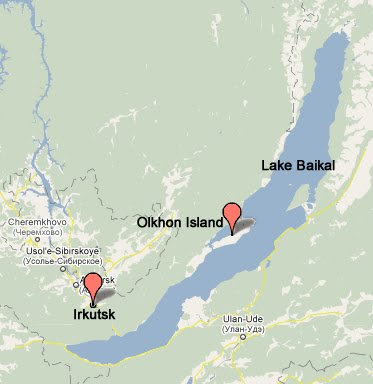
A Springtime Journey to Olkhon Island on Lake Baikal by Jane
CLICK HERE to see the complete set of photographs from this trip.

During the 2005-2006 school year, I taught at the
American Home in Vladimir, Russia. At the beginning of May 2006, my friends Misha, Joanna, and Youngmee and I decided to put our ten-day spring vacation to good use by venturing into Siberia in order to explore Olkhon Island on Lake Baikal.

Baikal is the world’s deepest lake – over 1600 meters at its deepest – and it contains about 1/5 of the world’s fresh water, which is more than in all of America’s Great Lakes combined. The lake is an amazing habitat, home to large numbers of aquatic plants and animals found nowhere else in the world, including the delicious omul fish and the endangered nerpa seal.

Olkhon is the largest island on the lake. Long and thin, it stretches roughly 72km end to end, while maxing out at around only 15km across. The island has long been a traditional home to Buryats, the indigenous people of the region, and although it was discovered by Russian explorers in the 17th century, it was only colonized by Russians during the Soviet era. Currently, the island is home to ethnic Buryats, Tatars, and Russians. Only about 1200 people reside there year-round, although as many as 300 people per day visit the island during the summer.
May in Siberia is definitely not “summer.” Late April to early May is, in fact, the most dangerous time of year to visit Olkhon. During the winter, Lake Baikal freezes to a great depth, allowing a heavily traveled “road” to open across the ice between the island’s main (and despite what GoogleMaps shows, essentially the only) village of Khuzhir, and the mainland. During the summer, a ferry frequently crosses the Olkhon Straits between the mainland village of Sakhyurta and the northeastern tip of the island.

During late spring, however, transport to and from Olkhon is rather dicey. As the weather warms and the ice weakens, travel by vehicle across the “road” is no longer possible. Most residents of Olkhon simply remain island-bound until the Olkhon Straits have thawed. During this time, only the desperate, the brave, and the foolhardy attempt passage.

My friends and I arrived, via rail, in Irkutsk on the morning of May 3rd, and immediately boarded a marshrutka (a mini-van taxi/bus common to the former Soviet Union) for the village of Sakhyurta on Baikal’s northwestern shore. To our surprise, we four were not the only foreigners in the marshrutka, as there was a Norwegian traveler named Ingvild on board. She, like us, was planning to brave the springtime crossing to Olkhon, and as such, we liked her immediately. Of the remaining travelers crammed into the marshrutka, only two others (two young Russian women) were bound for Olkhon; the rest were headed to various tiny villages along the way.

The marshrutka bolted out of Irkutsk and flew along winding, hilly roads at an absurd pace, with no regard for rules of the road. After four hours of our driver passing blind, uphill, and into oncoming traffic, we were sufficiently numb to the concept of personal safety to render a springtime crossing to Olkhon perfectly feasible.

Upon reaching Sakhyurta, the four of us, our new Norwegian companion, and the two Russian women (who were residents of Olkhon) were transferred from our standard marshrutka into the Marshrutka from Hell: an ancient converted ambulance with grimy windows, a front seat, and nothing but a dank, rusting cavern in the rear. The Russian women handily beat us to the front seat, leaving us to be bounced and jostled in the back for the 45-minute journey from Sakhyurta to the point where we intended to cross the ice.
The Marshrutka from Hell

The Marshrutka from Hell stopped at the shore of the still-frozen lake, and the driver advised us that we would wait there for our transport. Transport! That implied a vehicle. However, upon exiting the van and wandering down to the lake itself, we discovered that the ice didn’t exactly appear all that solid. It creaked and groaned, and moved up and down when we walked on it. Ingvild looked at the ice and looked back at us. “I’m Norwegian, and I know ice. This ice isn’t stable.” The five of us looked into the distance, where we could see Olkhon rising up against the horizon approximately five kilometers away, but at that moment we felt as though we would never make it to our destination.

And then we spotted a dark speck in the distance, moving towards us across the ice. It grew in size and took shape: a red motorcycle with a side car. The motorcycle stopped about twenty feet from shore. The Russian women immediately began tramping across the ice towards it, while a man disembarked from the side car and headed our way. As the driver of the motorcycle loaded up the Russians and their possessions and headed off towards Olkhon, we became acquainted with its erstwhile passenger, Valeriy. Valeriy was the owner of Solnechnaya, our hostel on Olkhon. He assured us that he had cross the ice under similar conditions numerous times, and that it was not dangerous. He said we would start walking across the ice, and that the motorcycle would meet us along the way to ferry the rest of us across in shifts.

We shouldered our backpacks and set off across the ice. Walking on ice was difficult for all of us – save Valeriy. I, being a native Floridian, was continually slipping and sliding, terrified that if I fell I would go right through the ice. We were about a kilometer from shore when the motorcycle returned, and I gleefully hopped into the side car. At that point, anything that got my feet off the ice seemed an excellent idea. With the side car stuffed full of backpacks, and with Ina and Youngmee mounted behind the driver, we hung on for dear life as the motorcycle hurtled across the lake. The ride was bracing, thrilling, and more than a little frightening… but we made it, safe and alive, to the shore of Olkhon. One round trip of the motorcycle later, and Misha, Joanna, and Valeriy had joined us.
We were the first tourists of the season to arrive on the island, and it was wonderful to have the place all to ourselves. We settled into our cabin at Solnechnaya (a wonderful place, which I highly recommend, although it – like the rest of the island – has no running water, so prepare yourself for banyas and pit squatters), and set about enjoying our three days on the island. From striking natural rock formations and areas consecrated holy by Buryat shamans, to the dusty streets of Khuzhir and the decaying remains of former Soviet villages, Olkhon has tons to offer the desolation traveler. In this case, pictures most definitely speak louder than words, so CLICK HERE to peruse my entire set.


Burkhan (also called Shamanka)
This rock formation just outside of Khuzhir is a holy site of Buryat shamanism
During our last full day on the island, we decided to see if the island’s museum was open. We had been told by Valeriy that the museum was excellent for a museum covering life on an island with such a tiny population. The museum is named after one Mr. Revyakin, a teacher and founder of the museum, and it contains exhibits representing the traditional lifestyles of the Buryats and the original Russian settlers, as well as exhibits on the plant and animal life endemic to Baikal. But to be honest, the best part of the museum was its docent, a tiny, ancient woman, who was passionate about the museum and its contents, and who turned out to be the daughter of Mr. Revyakin himself! After hearing how and when the five of us had crossed the lake, she had us gather around an old motorcycle that was on display, and she told us the following story:

The motorcycle once belonged to Mr. Revyakin. One day in early May (!) Revyakin and a friend decided to cross the ice on his motorcycle, as the ice seemed thick and firm. The friend was carrying a large and heavy bag of fish, which was strapped to his back. They were in the process of crossing the lake when suddenly the ice broke, and the two men and the motorcycle fell through. Revyakin was able to climb free, and then he had to cut the bag of fish off of his friend’s back, in order to pull him out of the ice. The two men reached the shore in a state of hypothermia, lucky to be alive. Two years later, a fisherman “caught” the motorcycle in his net. Revyakin cleaned it up, put some gasoline in the tank, and it worked! The moral of the story was that under no circumstances were we to cross by motorcycle on our way back to the mainland. Luckily for us, she told us that the ice at the narrow Olkhon Straits would be melted enough for us to cross the following day by boat, which we did.


CLICK HERE to view the entire set of photographs from this trip.

Friday, October 15, 2010

Dead Lands of Belarus: Travels Along A Desolate Border by Ben R.

[To see the entire set of photographs accompanying this post, click here.]
The above is a map of Belarus. The areas in varying shades of red are those affected by radiation from Chernobyl, with the darkest shades of red being those most contaminated.


I'm fascinated by maps. I spend hours tracing my fingers over them, following winding tropical rivers, exploring distant mountain ranges, following the contours of jagged borders, imagining what those places are like. It was whilst exploring a Soviet road atlas that my finger was drawn over to Belarus, that unknown land of our great continent. As I traced my finger over the map, following roads and contours, I noticed that in the far east of the country stretching along the Belarus/Russian border were the names of villages with their names in brackets; it wasn't something I had seen before. Sometimes there were clusters of villages, their names enclosed in said punctuation marks, surrounding a village whose name was not shackled by the two curved lines of English grammar... and then in another place, the opposite: un-bracketed names surrounding one small village which had its name in brackets. There were tens of them stretching from north of Gomel all the way down to Komarin in the far south of the country. I investigated and discovered that these were the villages which had suffered the brunt of the Chernobyl accident lying as they were in the path of the prevailing winds on that April day in 1986. They were the places that had been deemed uninhabitable by the Soviet/Belarusian government and had therefore been evacuated and scrubbed from history. My Belarusian friends had never been to any of these villages or the area in general so were unable to offer any more info regarding what exactly was to be found there, were the places bulldozed and buried or were they just evacuated and left intact in the hope of re-populating them one day? I decided to visit one.


The above details the places mentioned below.


It took me 2 days to drive from England to Belarus. I entered Belarus at a quiet border post south of Brest on a summer's evening and immediately stepped backwards to a more tranquil time. There were no advertisements, no street lights or signs of modernism, it was as though I was driving through one of Constable's paintings. The road east followed the Pripyat river, from which the town near where the Chernobyl reactor is located took it's name. The problem with driving in a 19th century land is that there are no road signs indicating the speed limit; consequently, I was radar gunned within an hour and fined $20. I drove on more slowly and as the night's blackness closed in I found a small parking area in the woods and parked up for the night, hoping sleep would come quickly so as not to be unnerved by the total silence and blackness of the woods.


I awoke to a misty landscape and drove on through vistas of barren farmland and huge tracts of forest, forests that would once have hidden partisans, forests that would now be hiding something just as deadly. The road was mostly empty, but occasionally I drove through small villages that lined the highway, just 20 or so Izbas their fences painted in the colours of the Belarusian flag. As I neared the East of the country the verge of the roads by the forests occasionally had wooden signs painted with warnings not to pick mushrooms or berries,no doubt due to radiation levels, yet I often drove past Babushkas selling buckets filled to the brim with pine nuts and berries, products no doubt harvested from the same forests. I stopped to buy some honey from a babushka and she asked me where I had come from. When I said I had driven from London, she asked me how many villages away that was; life beyond the village seemed to have little meaning.


The above sign says that it is forbidden to pick mushrooms and berries as this is dangerous to your life.

At Mozir I turned right following the Pripyat south to Hoiniki, there was no traffic except the odd Lada or Soviet built motorcycles. In the distance of some fields stood factories and commercial buildings that seemed long since abandoned, windows missing, roofs with holes in, and their approach roads overtaken by nature. In the entire drive I did not see any wildlife except some crows in the fields, no rabbits or squirrels dashing across the road, no deer in a field. South of Hoiniki I started seeing signs forbidding entry into the forest, radiation symbols on posts, signs saying permit holders only, and 'Danger' written on trees. I had arrived at the zone.

My plan was never to go into the official de-markated ecological disaster zone, that would be for another time when I could arrange permits and local knowledge. Of course I could have just crossed in unofficially to look around, but the idea of hiking through areas of possible cancer inducing levels of radiation without so much as a pair of Wellington boots or a Geiger counter wasn't really an appealing one. The places I was going to go were dangerous enough, as people had constantly warned me. Instead I wanted to visit one of the abandoned villages and then some places that were still inhabited to see how life was progressing there.

I studied my map and decided to head for the 'bracketed' village of Omelkovshina, just north of Hoiniki. I had decided to visit the villages north of Hoiniki as I presumed that as they were further from the reactor they might be somewhat safer radiation wise, I'll never know for sure. I followed the main road before finding the turning. At the crossroads was a small cluster of pretty Izbas and and a village shop outside of which sat some old men, as I turned and drove past them they all turned and stared at me, outsiders obviously didn't come here too often. The road passed through the small village of Dubrovitsa, in the middle of which stood a derelict building that looked like a bomb had exploded in it as rubble lay all around the building, I drove on past the village cemetery which was well tended to, the photos of the dead welded to the blue metal crosses as is the custom. Belarus was the most well kept country I had ever visited, people took pride in their houses and gardens and villages were all freshly painted in matching colours. As I came to the far end of the village the paved road ended and just a lonely rutted disused track led into the distance with the forest visible on the horizon. It was the road to Omelkovshina. I continued on, excited about what I would find. It felt like I was driving out of the known world into terra-incognita: 'Here be Dragons!'


Grave marker in the village of Dubrovitsa

I drove on following the road for about 6 or 7 miles entering the forest, civilization receding in my rear view mirror, there were no signs of life, no people, just dark woods enveloping me, and then, like in fairy tales, I entered a clearing and another world; I was inside the 'Brackets' for the first time. I'd reached Omelkovshina.

I got out of the car and stepped onto the old tarmac road of the village's main street and headed into 'town'. The village was dead, nobody lived here nor had done for a very, very long time, probably since April 1986, but I could see the signs of its previous inhabited self. There was the 'Dom Kulturi', its timbers intact, its wallpaper peeling but surviving Belarus's elements. There was the old village shop, overgrown and rotting, foxgloves now growing where once would have stood jars of essentials. Then there were houses, maybe 30 or 40, in different states of decay. Some were almost completely enveloped by nature, whilst others just needed a few minor repairs to be habitable again. Some houses had gardens that were so beautiful, filled as they were with stunning arrays of purple and red flowers and weeds that it looked as though they must have been tended by gardeners. Butterflies swirled about in the afternoon sunshine. As I entered houses, I found them to be full of swallows’ nests, baby chicks chirping their mouths open waiting for their parents to return with food. As I explored the undergrowth at the back of what seemed once to have been a government building of some sort I heard something large running through the bushes. I was gripped by a sudden fear; it was probably just a wild pig or a deer, but I suddenly felt vulnerable imagining escaped prisoners jumping out of the forest and attacking me with shanks. A body would never be found here.


Inside an abandoned home in Omelkovshina

I explored deeper, pushing open unlocked doors, finding signs of the village's previous inhabitants, a framed photo of a man in Soviet clothing, some Soviet banknotes, a rotten calender on a kitchen wall. I had stepped through a worm hole and entered The Soviet Republic of Belarus, circa the 1980s. I sat down at a kitchen table and ate my bread and honey as the previous inhabitants no doubt did 25 years ago. I explored some more, looking in sheds, exploring back yards and empty houses. One thing was certain, the village had been totally left to die, there was no chance of restoring it in the future should the radiation level drop to normal levels. It would be too expensive, and besides, the old residents had probably settled in their new lives with little inclination to return to the forest.

I walked down the main street to the far end of the village where a track led to another bracketed village that was marked on my map but the path was undriveable and I didn't feel like walking for miles through the forest exposing myself to even more radiation. I had read of huge packs of wolves inhabiting these places and other animals pushed to extinction in Europe re-building colonies here but I saw no evidence of this and presume that that is in the zone itself. I'd hoped to find an overgrown Lenin statue but it was a wooden village so my photo opportunity was not to be. It was unlike anywhere I had been on my travels before, streets of derelict buildings that within my life time had been full of life. I wanted to spend a long as possible there as there was always one more door to open, another window to peer inside, like finding an old chest in an attic and wanting to explore all its contents in the hope of finding some vital piece of information… but as evening approached I had to leave the village, I headed back to the main road, and back to life.

This part of Belarus had been hit hard by Chernobyl; abandonment and desolation was everywhere. Apartment buildings abandoned and uncompleted, warehouses being broken apart by nature’s instinct to replicate, roots cracking concrete, and the elements helping a hand. These rotting concrete structures affected me more then the village I had visited, the wooden village had returned to nature which seemed a natural course of events but concrete and steel are altogether different, thought of as impregnable and ever lasting - yet not here in the dead zone. And people were living here amongst it. A disused shop sat next to a village house with a well tended garden, life and death had become blurred.

I reached the city of Gomel at nightfall and checked into the old soviet monolith in the centre of town. Gomel was full of life, university students promenaded along the river bank in the summer evening, bottles of Baltika in hand. It seemed strange to be amongst such energy and life after a couple of days spent in rural Belarus. Yet Gomel was surrounded by contaminated land. The fear in 86 was that this city would need evacuating which would no doubt have made Gomel the largest ghost town on the planet but, the radiation mostly passed it by, the theory being that the heat given off by the city had pushed the clouds on to other areas. I explored the city which was built entirely in the Socialist Realist style, Corinthian columns with wheat sheaf motifs. I had an evening clubbing and getting drunk with Gomel's hip young things, who all seemed perplexed by my choice of holiday location. Discussion of Chernobyl stirred strong emotions amongst them, many angry at the then Soviet government's decision to seed the clouds to ensure that the radiation was dumped mainly on the rural backwaters along the Rus/Belarus border.

In the morning I stocked up on food for my journey to the border and in light drizzle I drove East, I didn't have long to see the first signs of abandonment. Gomel's outskirts were an array of abandoned factories, houses, and overgrown wasteland. Just past the town of Dobrush I headed south through empty fields towards the village of Korma. Rusted signs for long defunct state farms marked my way, rotting combines lay outside derelict chicken sheds, the dark brooding skies signifying impending storms. I drove into a small village not marked on my map, Horoshovka, situated just a mile from the fenceless border with Russia. It was an inhabited village, yet abandonment was everywhere. I parked and explored a derelict school, its climbing frames now covered in vines, textbooks littering the floor. I found an abandoned apartment building 2 stories high, I explored the ground floor apartments which were filthy and covered in dog shit; the rooms stank. On the balcony lay the rotten carcass of a dead cat, it's odour long since dissipated into the ether. I climbed the stairs and was looking around another empty apartment when I heard people coming up the stairs. Not sure of the reaction I would receive, being a foreigner photographing the village's squalor, I stood still hoping they would not hear me. I needn't have worried as they knocked on an apartment door and were let in. I couldn't believe that people were still living in the building which to all intents and purposes looked ready for demolition. It was hard to believe I was in Europe and not some war zone. The village reminded me of images I had seen of war torn Bosnia.
Inside an abandoned school in Horoshovka

I drove along the Russian border stopping to photograph and explore villages and buildings. There were no other cars on the roads, even in the villages I rarely saw anybody just the occasional hunched figures escaping the drizzle under bus shelters and shop doorways,a drunk knocking on someone's door to ask for money. I couldn't imagine what work people had here, there was no apparent industry, few shops, most were probably employed by the local state farm, the ones which had survived. I drove back up to Horoshovka, past caved in government buildings, an old stolovaya, its kitchen cupboards left where they had always stood, weeds growing to the height of the lintels.

My Belarusian road atlas showed a track leading across the border from Horoshovka to the Russian village of Lisiye but when I asked in the local shop where to find the path nobody could tell me, it did not seem as though there was any coss border traffic or contact. I eventually found an old man who directed me down a path, I drove down past abandoned houses, the same chirping of swallows audible through the glassless window frames. I parked up and continued on foot towards the Russian border, its boundary being marked by a thin line of trees in a field. I didn't have a Russian visa, and being caught would most likely have blacklisted me from ever receiving one, so I walked fast hoping nobody was watching, but as there was nobody in sight between me and the half a kilometer to the village so I walked on. I crossed into Russia and briskly followed the dirt track, avoiding the large puddles that had formed from the rain.


As I entered Lisiye I could tell I had left Belarus behind. Gone were the prettily painted picket fences and neat and orderly homes, instead were sagging wooden houses with broken machines parked in yards, a broken well, and a distinct feeling of neglect. I heard someone working on the other side of a fence so I popped my head over. The man working introduced himself as Stepan and he invited me in for tea nonchalantly as though foreigners were always coming into his village asking questions. I quizzed him about abandoned villages on this side of the border but the combination of my not so perfect Russian and his severe stutter made communication stilted and difficult, he said that there was an abandoned place a few miles away but I wasn't sure if he meant a building or village and not wanting to push my luck too far I decided not to find out and headed back into Belarus instead, relieved to have mde it without any problems.

Whilst looking at the local war memorial in Horoshovka I was approached by a local woman who invited me for tea at her elderly mother's Izba. I spent the evening with her being taken from house to house visiting the village's residents and being fed huge quantities of food everywhere I went. I heard some incredible stories over cups of tea from women who were sent to Germany for forced labour in the war, of the partizans, of Stalin's time, and then of happy times in this sleepy backwater of the former USSR where nothing much seemed to happen. And then of course of the fear after the Chernobyl accident and the slow death of the villages in this area, and the slow death of some of the residents to the diseases it had induced.


From what I could gather the young families had been evacuated to apartments or purpose built townships on the outskirts of cities such as Minsk, Zhlobin, Svetlogorsk; others had been sent further away to the Baltics or Russia. And then the government had pulled out, abandoning schools and infrastructure. It must have been a massive logistical nightmare, one which would always mean that certain people had to be left behind, and I suppose the elderly were the ones to whom that fate would fall. I had noticed in my journey that there was a distinct lack of children despite it being the school holiday period, everyone I had met had been elderly. However the elderly that I met seemed to bare no bitterness at being left in these contaminated lands by their government. The only complaint I heard was the lack of medical care in the villages. Life here is hard, toilets are outside, most don't have piped water, there is no central heating and these elderly work their small plots and take care of their animals in Belarusian winters when temperatures drop to minus 30 centigrade at times. Hence high blood pressure and arthritis seem endemic here, I was constantly asked about medicines we had in the West for such ailments, a person with just a basic medical knowledge and a well stocked medicine cabinet could do an immense amount of good in these parts and bring real relief to a lot of needy people.

My time was up. As I drove West I was overcome by a distinct feeling of melancholy. This area of Belarus had suffered a terrible fate through no fault of it's own; it had been decided by nothing more then the wind direction on that April day. It was an area of higher then average birth defects, childhood cancer, and industrial and social collapse, yet the people I met remained stoic and at peace, it seemed like a metaphor for Belarus in general. But there is hope. The Belarusian government has a policy of re-populating areas where radiation levels have fallen to within safe levels, re-investment of infrastructure is mentioned but Belarus is not a rich country and hence it will probably take generations for tangible change to happen. I hope the future will be kinder than its past. Sometimes at the end of travel blogs the author writes something along the lines of "go see it before everybody discovers it" - no such words are needed for Belarus.


***
This article was written by Ben R, and all photographs were taken by Ben R, and may not be used without his permission. To see the full set of photographs accompanying this post, please click here.